California reservoirs: The state’s two largest are already at ‘critically low ranges’ and the dry season is simply starting
Warning: Undefined variable $post_id in /home/webpages/lima-city/booktips/wordpress_de-2022-03-17-33f52d/wp-content/themes/fast-press/single.php on line 26
2022-05-07 22:49:19
#California #reservoirs #states #largest #critically #ranges #dry #season #beginning
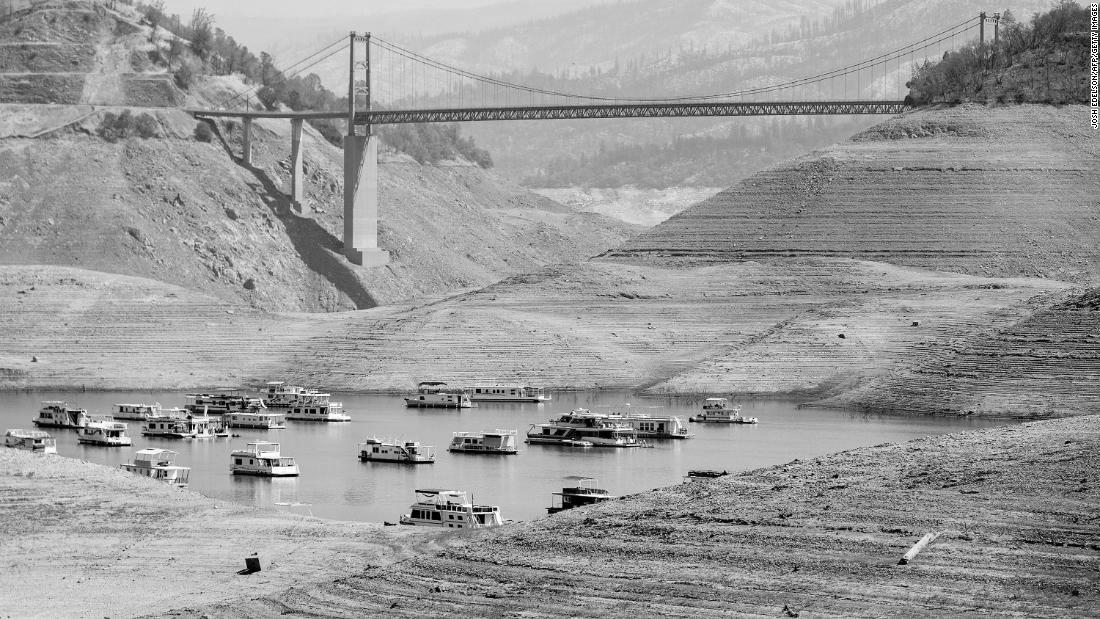
Years of low rainfall and snowpack and extra intense warmth waves have fed on to the state's multiyear, unrelenting drought circumstances, rapidly draining statewide reservoirs. And in line with this week's report from the US Drought Monitor, the 2 major reservoirs are at "critically low levels" on the point of the yr when they need to be the best.This week, Shasta Lake is simply at 40% of its complete capacity, the bottom it has ever been firstly of Could since record-keeping started in 1977. Meanwhile, further south, Lake Oroville is at 55% of its capacity, which is 70% of the place it needs to be round this time on common.Shasta Lake is the biggest reservoir in the state and the cornerstone of California's Central Valley Undertaking, a complex water system manufactured from 19 dams and reservoirs as well as more than 500 miles of canals, stretching from Redding to the north, all the way south to the drought-stricken landscapes of Bakersfield.
Shasta Lake's water levels at the moment are lower than half of historic average. In keeping with the US Bureau of Reclamation, solely agriculture customers who are senior water proper holders and some irrigation districts in the Eastern San Joaquin Valley will obtain the Central Valley Project water deliveries this 12 months.
"We anticipate that within the Sacramento Valley alone, over 350,000 acres of farmland will likely be fallowed," Mary Lee Knecht, public affairs officer for the Bureau's California-Great Basin Region, told CNN. For perspective, it is an area bigger than Los Angeles. "Cities and towns that obtain [Central Valley Project] water supply, together with Silicon Valley communities, have been decreased to health and safety wants solely."
Loads is at stake with the plummeting supply, said Jessica Gable with Food & Water Watch, a nonprofit advocacy group focused on meals and water security in addition to climate change. The approaching summer season warmth and the water shortages, she said, will hit California's most weak populations, notably those in farming communities, the hardest."Communities throughout California are going to suffer this 12 months in the course of the drought, and it's only a question of how much more they suffer," Gable informed CNN. "It is often the most vulnerable communities who are going to suffer the worst, so normally the Central Valley involves thoughts as a result of this is an already arid a part of the state with most of the state's agriculture and a lot of the state's power improvement, that are both water-intensive industries."
'Solely 5%' of water to be supplied
Lake Oroville is the largest reservoir in California's State Water Undertaking system, which is separate from the Central Valley Mission, operated by the California Department of Water Resources (DWR). It provides water to 27 million Californians and 750,000 acres of farmland.
Final year, Oroville took a serious hit after water ranges plunged to simply 24% of whole capability, forcing a crucial California hydroelectric power plant to close down for the primary time since it opened in 1967. The lake's water level sat properly below boat ramps, and exposed consumption pipes which usually sent water to energy the dam.Although heavy storms toward the top of 2021 alleviated the lake's record-low ranges, resuming the facility plant's operations, state water officials are cautious of another dire situation because the drought worsens this summer.
"The truth that this facility shut down last August; that never occurred earlier than, and the prospects that it's going to occur again are very actual," California Gov. Gavin Newsom stated at a news conference in April whereas touring the Oroville Dam, noting the climate crisis is altering the best way water is being delivered across the area.
Based on the DWR, Oroville's low reservoir ranges are pushing water companies counting on the state mission to "solely receive 5% of their requested supplies in 2022," Ryan Endean, spokesperson for the DWR, informed CNN. "These water companies are being urged to enact mandatory water use restrictions with the intention to stretch their accessible provides via the summer time and fall."
The Bureau of Reclamation and the DWR, in live performance with federal and state agencies, are additionally taking unprecedented measures to guard endangered winter-run Chinook salmon for the third drought year in a row. Reclamation officials are in the means of securing short-term chilling units to chill water down at one in every of their fish hatcheries.
Both reservoirs are a vital part of the state's larger water system, interconnected by canals and rivers. So even if the smaller reservoirs have been replenished by winter precipitation, the plunging water ranges in Shasta and Oroville may still affect and drain the rest of the water system.
The water level on Folsom Lake, for instance, reached almost 450 toes above sea stage this week, which is 108% of its historical common round this time of yr. However with Shasta and Oroville's low water levels, annual water releases from Folsom Lake this summer time may should be larger than regular to make up for the other reservoirs' significant shortages.
California relies on storms and wintertime precipitation to construct up snowpack within the Sierra Nevada, which then step by step melts throughout the spring and replenishes reservoirs.
Facing back-to-back dry years and record-breaking heat waves pushing the drought into historic territory, California obtained a style of the rain it was in search of in October, when the first big storm of the season pushed onshore. Then in late December, greater than 17 ft of snow fell within the Sierra Nevada, which researchers mentioned was sufficient to interrupt decades-old information.However precipitation flatlined in January, and water content material within the state's snowpack this 12 months was simply 4% of regular by the tip of winter.Further down the state in Southern California, water district officers announced unprecedented water restrictions final week, demanding companies and residents in parts of Los Angeles, Ventura and San Bernardino counties to chop out of doors watering to one day per week starting June 1.Gable stated as California enters a future much hotter and drier than anyone has skilled earlier than, officers and residents must rethink the way in which water is managed across the board, in any other case the state will proceed to be unprepared.
"Water is meant to be a human right," Gable mentioned. "However we're not considering that, and I feel until that modifications, then sadly, water scarcity is going to continue to be a symptom of the worsening local weather crisis."
Quelle: www.cnn.com